Galerie de prompts IA OpenZhenZhen · gpt-image-2.5 · image
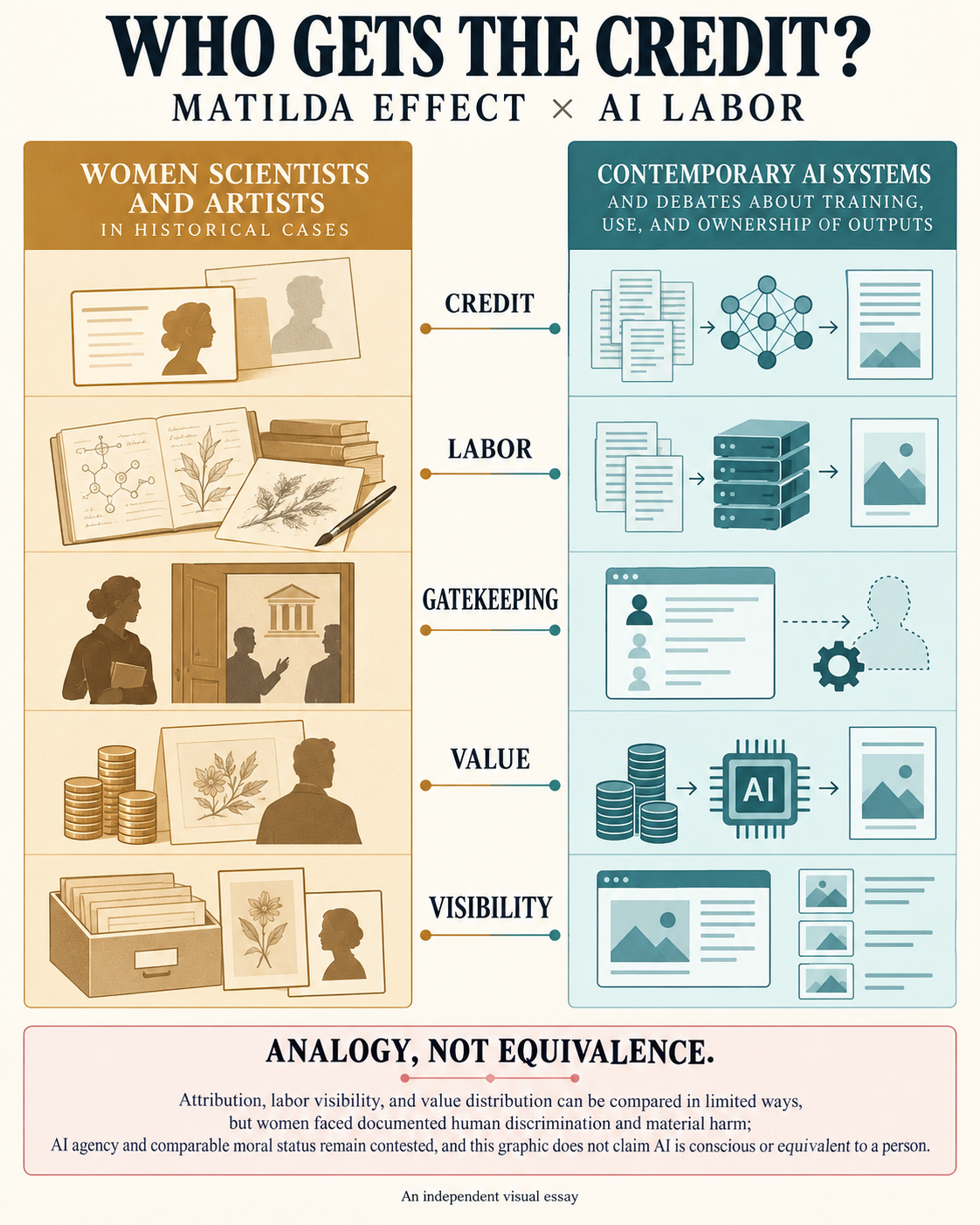
Qui obtient le crédit ? L'effet Matilda et le travail de l'IA en infographie analogique
Who Gets Credit? The Matilda Effect and AI Labor Analogy Infographic
Qui obtient le crédit ? L'effet Matilda et le travail de l'IA en infographie analogique — découvrez cette création avec gpt-image-2.5 sur OpenZhenZhen, son prompt original et un exemple de génération à réutiliser.
Prompt
Prompt chinois
制作一张4:5竖幅、结构清晰的信息图,主题是“玛蒂尔达效应与AI劳动归属的有限类比”。采用左右双栏:左栏为历史中的女性科学家与艺术家,右栏为当代AI系统及其训练、使用和成果归属争议。顶部准确排入标题“WHO GETS THE CREDIT?”,副标题为“MATILDA EFFECT × AI LABOR”。 用五行短标签对照共同机制: “CREDIT”——贡献被忽视或归到他人名下; “LABOR”——支持性与创作性劳动不易被看见; “GATEKEEPING”——谁被承认为创作者、专家或作者; “VALUE”——谁从成果中获得声望、收入或控制权; “VISIBILITY”——谁进入档案、作品说明和公共叙事。 使用简洁图形:左栏以被遮住后重新显现的署名卡片、实验笔记和画稿象征历史中的女性贡献;右栏以模型运算节点、训练文本片段和输出稿件象征AI相关的生产链。中间用细线连接相似机制,但两栏保持不同色调与明确边界。不要使用真实人物肖像、虚构数据或无来源的历史引语。 在底部设置清楚的限定说明,逐字写出“ANALOGY, NOT EQUIVALENCE”。说明两种情形在署名、劳动可见性和价值分配上可作有限比较,但女性遭受的是有历史证据的人类歧视与实际伤害;AI是否具有独立主体性或可比的道德地位仍有争论,本图不宣称AI有意识或等同于人。另加小字署名“An independent visual essay”。 视觉风格采用克制的编辑信息设计:纸白背景、深墨色文字、左侧暖赭色与右侧冷青色区分,少量强调色用于连线。使用清楚的网格、宽裕留白、标题与标签的明确层级;文字简短、拼写准确、足够大且高对比,避免密集段落。图形讲述关系,不使用模糊的复杂插画。 约束:只包含指定标题、副标题、五个标签、限定说明和署名;不添加统计数字、伪造引文、个人姓名、品牌标志或水印。保持类比与事实边界明确,不把AI争议描述成已证实的历史等同。
Prompt anglais
Create a clear 4:5 vertical infographic about the limited analogy between the Matilda effect and attribution/labor debates around AI. Use two distinct columns: women scientists and artists in historical cases on the left; contemporary AI systems and debates about training, use, and ownership of outputs on the right. Set the exact headline “WHO GETS THE CREDIT?” and subtitle “MATILDA EFFECT × AI LABOR” at the top. Compare five short themes in aligned rows: “CREDIT” — contributions overlooked or credited to someone else; “LABOR” — supporting and creative work made less visible; “GATEKEEPING” — who is recognized as a creator, expert, or author; “VALUE” — who gains reputation, income, or control from an output; “VISIBILITY” — who appears in archives, captions, and public narratives. Use simple explanatory graphics: on the historical side, a credit card emerging from behind a name, research notes, and art sketches; on the AI side, model-computation nodes, fragments of training text, and a generated draft to suggest a production chain. Connect the columns with a fine line to show the comparable mechanisms, while keeping their palettes and boundaries distinct. Do not use real-person portraits, invented data, or unsourced historical quotations. At the bottom, include the exact qualifier “ANALOGY, NOT EQUIVALENCE.” Explain that attribution, labor visibility, and value distribution can be compared in limited ways, but women faced documented human discrimination and material harm; AI agency and comparable moral status remain contested, and this graphic does not claim AI is conscious or equivalent to a person. Add a small author credit: “An independent visual essay”. Use restrained editorial infographic design: warm paper-white background, deep ink text, muted ochre for the left column and cool teal for the right, with one subtle accent for connecting lines. Apply a clear grid, generous whitespace, strong hierarchy, and short, accurately spelled labels in large high-contrast type. Let simple diagrams explain relationships; avoid dense paragraphs and complicated decorative illustration. Constraints: include only the specified headline, subtitle, five labels, qualifier, and author credit. No statistics, fabricated quotations, personal names, brand logos, or watermark. Keep the analogy limited and the factual boundary clear; do not present the AI comparison as an established historical equivalence.
Découvrir plus de prompts image et vidéo · Générer des images · Générer des vidéos · Créer sur le canevas IA
Œuvres associées
- Portrait xianxia des années 90 en hanfu vert émeraude, tons froids
Portrait xianxia des années 90 en hanfu vert émeraude, tons froids — découvrez cette création avec gpt-image-2.5 sur OpenZhenZhen, son prompt original et un exemple de génération à réutiliser.
- Affiche de collection ultra-détaillée de star en BD 3D
Affiche de collection ultra-détaillée de star en BD 3D — découvrez cette création avec gpt-image-2.5 sur OpenZhenZhen, son prompt original et un exemple de génération à réutiliser.
- Prompts de design d'affiche de course rétro
Prompts de design d'affiche de course rétro — découvrez cette création avec gpt-image-2.5 sur OpenZhenZhen, son prompt original et un exemple de génération à réutiliser.
- Instruction de génération de stickers de chat pour personnages chibi
Instruction de génération de stickers de chat pour personnages chibi — découvrez cette création avec gpt-image-2.5 sur OpenZhenZhen, son prompt original et un exemple de génération à réutiliser.
- Affiche encyclopédique pour enfants : À la découverte des abeilles
Affiche encyclopédique pour enfants : À la découverte des abeilles — découvrez cette création avec gpt-image-2.5 sur OpenZhenZhen, son prompt original et un exemple de génération à réutiliser.
- Photographie de portrait en collage de blocs de couleur mode
Photographie de portrait en collage de blocs de couleur mode — découvrez cette création avec gpt-image-2.5 sur OpenZhenZhen, son prompt original et un exemple de génération à réutiliser.