OpenZhenZhen AI プロンプトギャラリー · gpt-image-2.5 · image
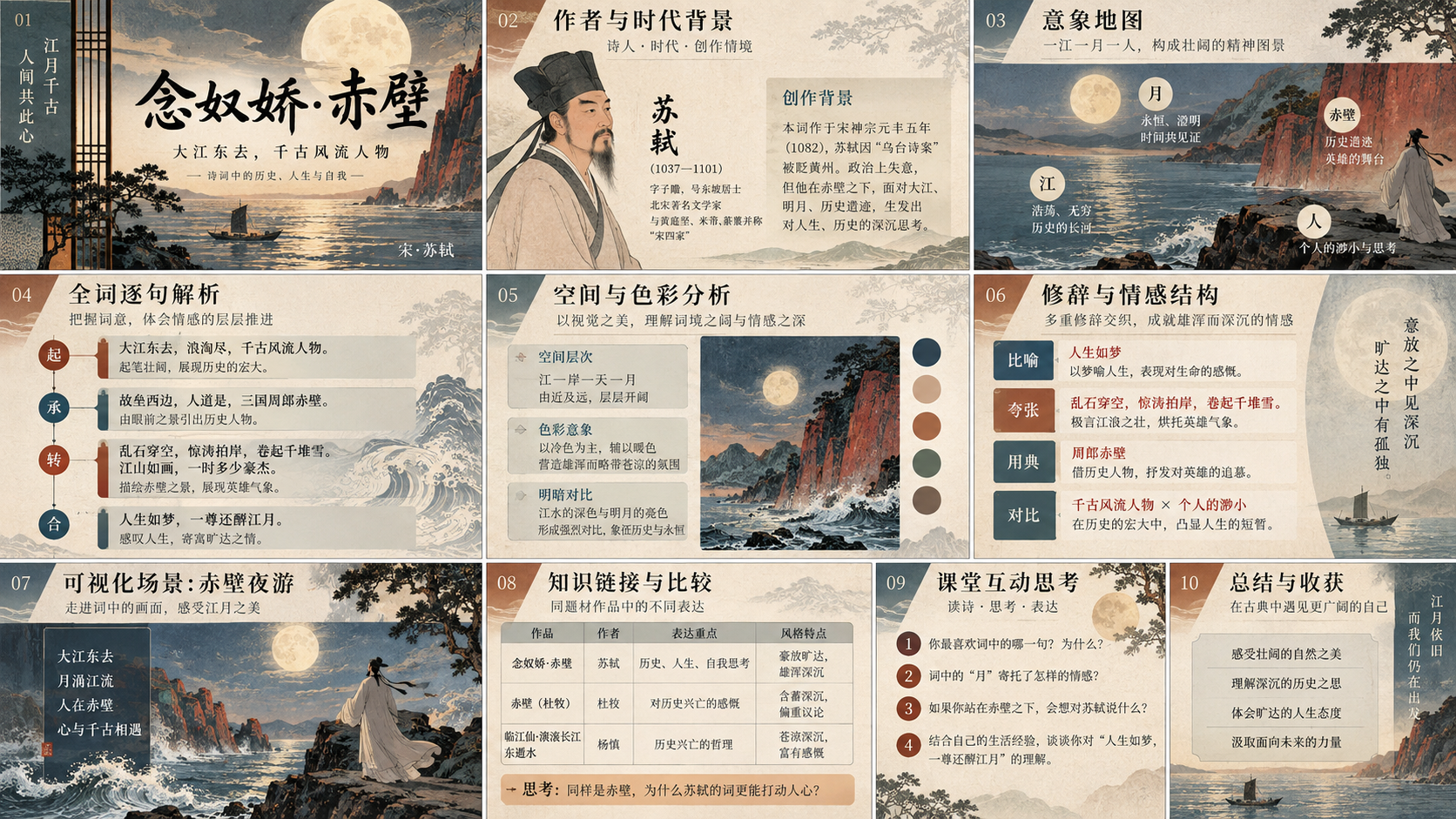
東洋古典美学 念奴嬌・赤壁 受賞教材デザイン
Eastern Classical Aesthetics: Nian Nu Jiao Red Cliff Award-Winning Courseware Design
「東洋古典美学 念奴嬌・赤壁 受賞教材デザイン」は gpt-image-2.5 を使用した作品です。OpenZhenZhen で元のプロンプトと生成例を確認し、創作の参考にできます。
プロンプト
中国語プロンプト
创建一套用于课堂展示的16:9横版10张幻灯片课件,主题为诗句解析——“念奴娇赤壁”。每张幻灯片都使用不同但属于同一系统的排版和信息呈现逻辑,确保老师可以直接用于高质量、课堂友好、具有竞赛级完成度的课件展示。建立统一而丰富的东方古典视觉语言:东方古典叙事体系、海派月份牌装帧、新中式编辑设计、侘寂美学、装饰艺术、格式塔视觉心理学、符号学和情绪化设计;可吸收俵屋宗达的华丽平面性、上村松园的含蓄人物气韵、威廉·莫里斯的连续装饰秩序、田中一光的东方现代版式和吕敬人的书籍设计逻辑,但不要复制具体艺术品。配色使用低饱和邻近色、明度阶梯、微妙冷暖差、主次色面积控制、局部高纯度视觉锚点和统一材质反射,形成温润雅致、克制而不寡淡的综合色调。构图交替使用黄金分割、三分法、动态对角线、非对称平衡、回环视觉动线、前中后景层叠、虚实对照、疏密节奏、框景与留白;保持主视觉焦点自然、信息层级清晰、装饰丰富但不拥挤。字体系统以纵向展示字和横向正文形成经纬对照:主标题使用具有书写性、碑帖骨架和现代压缩感的艺术字,副标题使用窄长衬线或仿宋结构,正文使用高可读性宋体逻辑;用粗细变化、重心错落、笔画延伸、字面大小差异、小字号字距扩张、行距留白、标点弱化和细线分隔建立古典书卷气与现代编辑感。10张内容逻辑应彼此不同,例如封面、作者与时代背景、意象地图、关键诗句拆解、空间/色彩分析、修辞与情绪结构、画面化场景、知识对照、课堂互动提问、总结回顾;所有教学文字必须清晰、准确、可读,不编造诗句或历史事实,不生成乱码。使用细腻纹理、半透明叠层、柔和晕染、精工纹样、纸张质感、轻微做旧和局部精致光泽,呈现清雅、温柔、含蓄、书卷气、东方浪漫、静谧、贵气、诗意、怀旧与高级感。每张保持16:9、版式独立、系统一致,适合投影阅读;只使用与“念奴娇赤壁”相关的准确标题和教学信息,不添加无关品牌、水印或装饰性乱码。
英語プロンプト
Create a 10-slide 16:9 landscape lesson deck for classroom presentation on line-by-line poetry analysis of “念奴娇赤壁”. Every slide must use a distinct layout and information-presenting logic while belonging to one coherent system, producing a polished, classroom-friendly deck with competition-level finish that a teacher can present directly. Establish a unified but rich Oriental classical visual language combining Eastern classical narrative, Shanghai calendar-poster binding, New Chinese editorial design, wabi-sabi, Art Deco, Gestalt visual psychology, semiotics, and emotional design. You may draw on the gorgeous flatness of Tawaraya Sōtatsu, the subtle character atmosphere of Shoen Uemura, the continuous decorative order of William Morris, the Eastern modern layout of Ikko Tanaka, and the book-design logic of Lu Jingren, but do not copy specific artworks. Use low-saturation analogous colors, controlled lightness steps, subtle cool-warm differences, primary/secondary area ratios, local high-purity visual anchors, and hue-consistent material reflections to create a warm, elegant, restrained palette that is never bland. Alternate golden-section, rule-of-thirds, dynamic diagonal, asymmetrical balance, looping visual flow, foreground-middle-background layering, figure-ground contrast, density rhythm, framing, and white-space strategies; keep the focal point natural, hierarchy clear, and decoration rich without crowding. Build a typographic system contrasting vertical display characters with horizontal body text: use expressive title lettering with calligraphic and stele-derived structure plus modern compression, narrow serif or Fangsong-inspired subtitles, and highly legible Song-style body text. Use weight variation, offset visual centers, extended strokes, scale contrast, expanded tracking, generous leading, subdued punctuation, and fine dividers to combine classical bookish atmosphere with modern editorial clarity. Give the 10 slides distinct content logics, such as cover, author and historical context, imagery map, key-line breakdown, spatial/color analysis, rhetoric and emotional structure, visualized scene, knowledge comparison, classroom interaction questions, and summary review. All teaching text must be accurate, clear, and readable; do not invent poem lines or historical facts, and do not generate garbled characters. Use delicate textures, translucent layers, soft washes, refined patterns, paper grain, subtle aging, and selective polished highlights to evoke elegance, tenderness, restraint, bookish atmosphere, Oriental romance, quietness, poetry, nostalgia, and sophistication. Keep every slide 16:9, individually composed but system-consistent and projector-readable. Use only accurate titles and teaching information related to “念奴娇赤壁”; add no unrelated brands, watermarks, or decorative gibberish.
画像・動画プロンプトをもっと見る · 画像を生成 · 動画を生成 · AI キャンバスで作成
関連作品
- 90年代クールトーン仙侠風 翡翠色漢服の人物像
「90年代クールトーン仙侠風 翡翠色漢服の人物像」は gpt-image-2.5 を使用した作品です。OpenZhenZhen で元のプロンプトと生成例を確認し、創作の参考にできます。
- 超精巧3Dコミック風スター收藏ポスター
「超精巧3Dコミック風スター收藏ポスター」は gpt-image-2.5 を使用した作品です。OpenZhenZhen で元のプロンプトと生成例を確認し、創作の参考にできます。
- レトロレーシングポスターのデザインプロンプト
「レトロレーシングポスターのデザインプロンプト」は gpt-image-2.5 を使用した作品です。OpenZhenZhen で元のプロンプトと生成例を確認し、創作の参考にできます。
- ちびキャラチャットスタンプ生成プロンプト
「ちびキャラチャットスタンプ生成プロンプト」は gpt-image-2.5 を使用した作品です。OpenZhenZhen で元のプロンプトと生成例を確認し、創作の参考にできます。
- 子ども向け科学百科ポスター ミツバチを知ろう
「子ども向け科学百科ポスター ミツバチを知ろう」は gpt-image-2.5 を使用した作品です。OpenZhenZhen で元のプロンプトと生成例を確認し、創作の参考にできます。
- ファッションカラーブロックコラージュポートレート写真
「ファッションカラーブロックコラージュポートレート写真」は gpt-image-2.5 を使用した作品です。OpenZhenZhen で元のプロンプトと生成例を確認し、創作の参考にできます。