OpenZhenZhen AI プロンプトギャラリー · gpt-image-2.5 · image
郵便幾何学建築切手の生成
Postal Geometric Architecture Stamp Generation
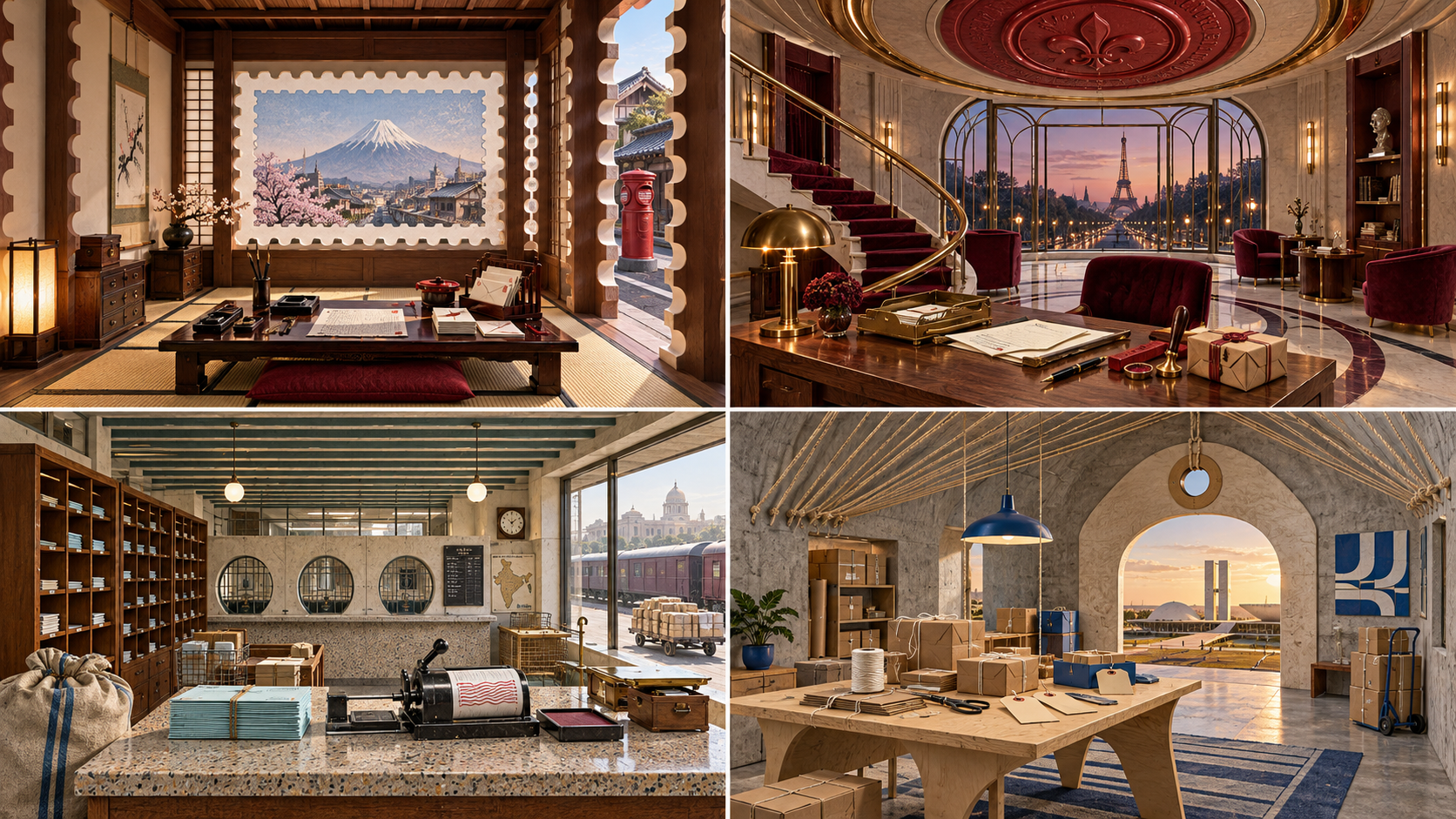
「郵便幾何学建築切手の生成」は gpt-image-2.5 を使用した作品です。OpenZhenZhen で元のプロンプトと生成例を確認し、創作の参考にできます。
プロンプト
中国語プロンプト
创作一块 16:9 建筑概念板,采用整洁的 2x2 网格。每个象限都是由一个具体国家、时代和通信文化推导出的完整房间尺度邮政微缩场景。不得出现人物;仅通过布置好的家具、工具、信件和包裹表现书写或寄送仪式。四个房间大小相等并完整入镜。 通信文化场:把笔触、折叠纸张和想象中走向邮筒的路径转化为定向空间几何;把火漆漩涡、麻绳环和邮戳圆环转化为曲线动线;把墨水、邮票、纸张和封装工具的密度转化为室内视觉密度。避免泛化怀旧,并只采用下列四个明确 gate。 Gate 1——日本东京,明治时代,1899 年;齿孔邮票几何。创建锯齿边缘写信室:邮票齿孔变成有节奏的木质墙柱,富士山邮票插图变成主窗壁画。布置矮书桌、笔搁、砚台、和纸信封,窗外可见红色圆柱邮筒。通过有序物件暗示折信和写地址的仪式。使用雪松、深色漆器、米白和纸与朱红点缀,采用清澈晨光。 Gate 2——法国巴黎,装饰艺术时代,1925 年;火漆几何。创建圆顶通信沙龙:放大的封印压痕形成天花浮雕,流动的酒红丝带形成弧形楼梯扶手。加入胡桃木写字台、黄铜信盘、钢笔、米白信封、火漆和小包裹。窗外是黄昏时分的几何化巴黎街道。使用胡桃木、黄铜、酒红天鹅绒、象牙纸和暖琥珀灯光,暗示封缄正式信件的仪式。 Gate 3——印度新德里,独立初期,1950 年;邮资机印与邮资戳几何。创建网格模块化邮局:水平邮资条纹变成天花结构梁,邮戳圆环变成服务窗口。加入水磨石柜台、柚木分拣柜、手动邮资机、帆布邮袋、印台和整齐叠放的航空邮简。窗外是明亮正午薄雾中的铁路邮件站台。使用砂岩、水磨石、柚木、黄铜和褪色蓝绿色纸张,暗示称重、盖资和分拣外寄邮件的流程。 Gate 4——巴西巴西利亚,现代主义时代,1960 年;麻绳与货运标签几何。创建悬吊包裹屋:绷紧麻绳变成椽子和索具,放大的货运标签孔变成拱形门洞。加入模压胶合板打包桌、牛皮纸包裹、棉绳、剪刀和空白路由标签。门外是金色午后光中的巴西利亚新城天际线。使用清水混凝土、浅色胶合板、牛皮纸板、棉绳和钴蓝点缀,暗示包裹的包装、捆扎与发运。 将四个 gate 渲染为高度精细的微缩建筑模型,清楚表现纸纤维、墨水、木纹、金属包浆、织物、火漆、绳索和混凝土触感。统一采用略高的四分之三视角、受控产品摄影光和清晰象限分隔。严格保留每项邮政几何转换。不得出现人物、面孔、手、额外 gate、国家或时代混用、随机物件、可读品牌名、标志、水印、乱码文字、被裁切房间或装饰性外边框。
英語プロンプト
Create a 16:9 architectural concept board in a clean 2x2 grid. Each quadrant is a complete room-scale postal diorama derived from one specific country, era and correspondence culture. Show no people; communicate each writing or sending ritual through arranged furniture, tools, letters and parcels. Keep all four rooms equally sized and fully visible. Correspondence culture field: translate pen strokes, folded paper and the imagined walk to a postbox into directional room geometry; translate wax-seal swirls, twine loops and postmark rings into curved circulation; translate the density of ink, stamps, paper and sealing tools into the visual density of each interior. Avoid generic nostalgia and select exactly the four gates below. Gate 1 — Japan, Tokyo, Meiji era, 1899; perforated postage-stamp geometry. Create a serrated-edge writing room in which stamp perforations become rhythmic timber wall pillars and a stylized Mount Fuji stamp vignette becomes the main window mural. Furnish it with a low writing desk, brush rest, inkstone, washi envelopes and a red cylindrical street postbox visible outside. Imply the ritual of folding and addressing a letter through the ordered objects. Use cedar, dark lacquer, cream washi and vermilion accents in clear early-morning light. Gate 2 — France, Paris, Art Deco era, 1925; wax-seal geometry. Create a domed correspondence salon in which an enlarged seal impression forms the ceiling relief and a flowing burgundy ribbon becomes a curved stair rail. Include a walnut writing bureau, brass letter tray, fountain pen, cream envelopes, sealing wax and a small parcel. Through the window show a geometric Paris boulevard at dusk. Use walnut, brass, burgundy velvet, ivory paper and warm amber lamps to imply the ritual of sealing a formal letter. Gate 3 — India, New Delhi, early post-independence era, 1950; meter and frank-mark geometry. Create a grid-modular post office in which horizontal franking bars become structural ceiling beams and postmark circles become service-window openings. Include a terrazzo counter, teak sorting cabinet, manual franking machine, canvas mailbag, ink pad and neatly stacked aerogrammes. Through the window show a railway mail platform in bright midday haze. Use sandstone, terrazzo, teak, brass and faded blue-green paper tones to imply weighing, franking and sorting outgoing mail. Gate 4 — Brazil, Brasília, modernist era, 1960; twine-and-shipping-tag geometry. Create a suspended parcel house in which taut twine becomes rafters and rigging, while an oversized shipping-tag hole becomes the arched doorway. Include a molded plywood packing table, kraft-paper parcels, cotton twine, scissors and blank routing tags. Through the opening show Brasília's new civic skyline in golden late-afternoon light. Use raw concrete, pale plywood, kraft cardboard, cotton rope and cobalt-blue accents to imply wrapping, tying and dispatching a parcel. Render all four gates as highly detailed miniature architectural models with tactile paper fibers, ink, wood grain, metal patina, cloth, wax, rope and concrete. Use a consistent slightly elevated three-quarter camera angle, controlled product-photography lighting and crisp separation between quadrants. Preserve each postal geometry transformation exactly. No people, faces, hands, extra gates, mixed countries or eras, random objects, legible brand names, logos, watermarks, gibberish text, cropped rooms or decorative outer border.
画像・動画プロンプトをもっと見る · 画像を生成 · 動画を生成 · AI キャンバスで作成
関連作品
- 東洋禅意の中秋明月と月兎のミニマルポスター
「東洋禅意の中秋明月と月兎のミニマルポスター」は gpt-image-2.5 を使用した作品です。OpenZhenZhen で元のプロンプトと生成例を確認し、創作の参考にできます。
- 手作り重ね紙アート絵本の場面転換
「手作り重ね紙アート絵本の場面転換」は gpt-image-2.5 を使用した作品です。OpenZhenZhen で元のプロンプトと生成例を確認し、創作の参考にできます。
- 陽光の歩道橋の階段、大人の女性の日常スナップ
「陽光の歩道橋の階段、大人の女性の日常スナップ」は gpt-image-2.5 を使用した作品です。OpenZhenZhen で元のプロンプトと生成例を確認し、創作の参考にできます。
- 連続するポートレートで満たされた文字のインディペンデント・ファッションポスター
「連続するポートレートで満たされた文字のインディペンデント・ファッションポスター」は gpt-image-2.5 を使用した作品です。OpenZhenZhen で元のプロンプトと生成例を確認し、創作の参考にできます。
- 同じ成人女性のパリ・ドバイ・シドニー旅行ポスター
「同じ成人女性のパリ・ドバイ・シドニー旅行ポスター」は gpt-image-2.5 を使用した作品です。OpenZhenZhen で元のプロンプトと生成例を確認し、創作の参考にできます。
- 夏の大学教室で大人の女性が秘めた恋を回想する
「夏の大学教室で大人の女性が秘めた恋を回想する」は gpt-image-2.5 を使用した作品です。OpenZhenZhen で元のプロンプトと生成例を確認し、創作の参考にできます。