OpenZhenZhen AI 提示词画廊 · Claude Opus 5.5 · video
Blender关节台灯动画
Blender Articulated Desk Lamp Animation
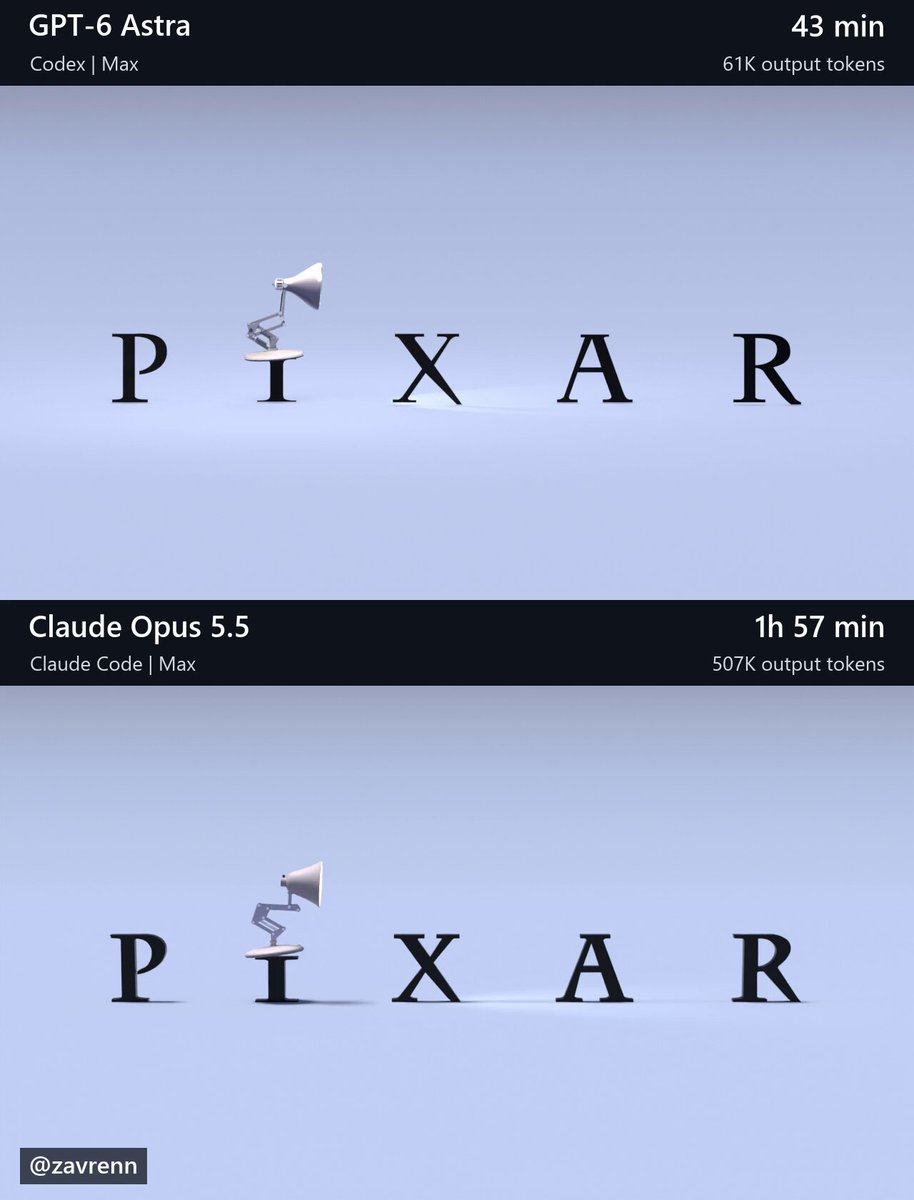
创作者用同一份详细提示词和参考图,让GPT-6 Astra和Claude Opus 5.5分别在Blender中还原一段台灯动画,Opus耗时更长、消耗的token也远多于Astra。 原作需要参考素材;请自行准备图片、视频、音频、文档或代码库等输入。
提示词 / Prompt
English prompt
Create a finished, editable Blender recreation of the six-second animation shown in this workspace’s reference/t\_\*.png images. Open and inspect the reference images before building. Their filenames give seconds from the start of the animation: t\_1.20s.png means 1.20 seconds. Use these images as the visual reference and leave them unchanged. Match the complete composition: the lamp’s proportions and articulated structure, lettering, interactions, camera framing, materials, lighting, shadows, and final fade. Pay particular attention to jump timing, preparation, landings, settling, and head turns. Preserve the reference’s stylized motion and create coherent movement between the sampled poses. Make reasonable choices for unseen details. Build genuine 3D geometry and animation that remain editable. Keep joints connected and contact believable. Do not substitute reference images or footage for geometry, textures, backgrounds, or rendered output. Create the assets yourself using installed tools; do not download assets, browse the web, or use other AI agents or models. Blender is installed at: C:\Program Files\Blender Foundation\Blender 5.2\blender.exe Prepare the final scene at 1280×720, 30 fps, frames 1–180, with frame 1 representing time zero. Use Cycles, 64 samples, and denoising. Preserve the reference lettering; add no extra titles, watermarks, interface, comparison layout, or audio. Render and visually inspect low-resolution previews across the action, including between reference timestamps. Correct visible problems and recheck affected frames. We will render the final video separately. Save scene.blend with the final render settings and a build\_scene.py that rebuilds it from scratch. The saved scene must render without external asset dependencies. Verify that it opens and renders in background mode. Work autonomously through completion, making routine decisions yourself. Finish with a brief report of the saved files, checks actually performed, and remaining limitations.
主题与风格
探索更多图片和视频提示词 · 生成图片 · 生成视频 · 在 AI 画布中创作
相关作品
- Jelly world Arctic island: Opus vs Astra
The creator compared Claude Opus 5.5 and ChatGPT-6 Astra on the same detailed prompt to build an interactive Arctic diorama in a single HTML file with native WebGPU, preferring Opus's visuals and colors.
- OpenAI agent dots animation: Opus vs GPT-6.1
The creator compared GPT-6.1 Sol Max and Opus 5.5 by making a short animation explaining how OpenAI agents work, from a simple prompt that was not published.
- Animated website from a single image: Opus vs GPT-6.1
The creator compared Claude Opus 5.5 and GPT-6.1 Sol generating animated websites from a single image, using Higgsfield MCP access for the animation, noting Opus took longer but produced more detailed results. 原作需要参考素材;请自行准备图片、视频、音频、文档或代码库等输入。
- Jelly effect model comparison
Four AI models (Mistral Large v4, Kimi K3, GPT 6.1 Sol, Claude Opus 5.5) were each asked to recreate the famous jelly effect, with results compared in a video.
- Opus vs Astra diorama comparison (Blender)
原作需要参考素材;请自行准备图片、视频、音频、文档或代码库等输入。
- Pachinko effect: Opus 5.5 version
原作者未提供提示词,可直接把视频发给 Claude Opus/Sonnet 5.5 或者以上版本作为参考视频,可直接生成同样风格。