OpenZhenZhen AI 提示词画廊 · Claude Opus 5.5 · video
果冻糖果模拟对比
Jelly Candy Simulation Comparison
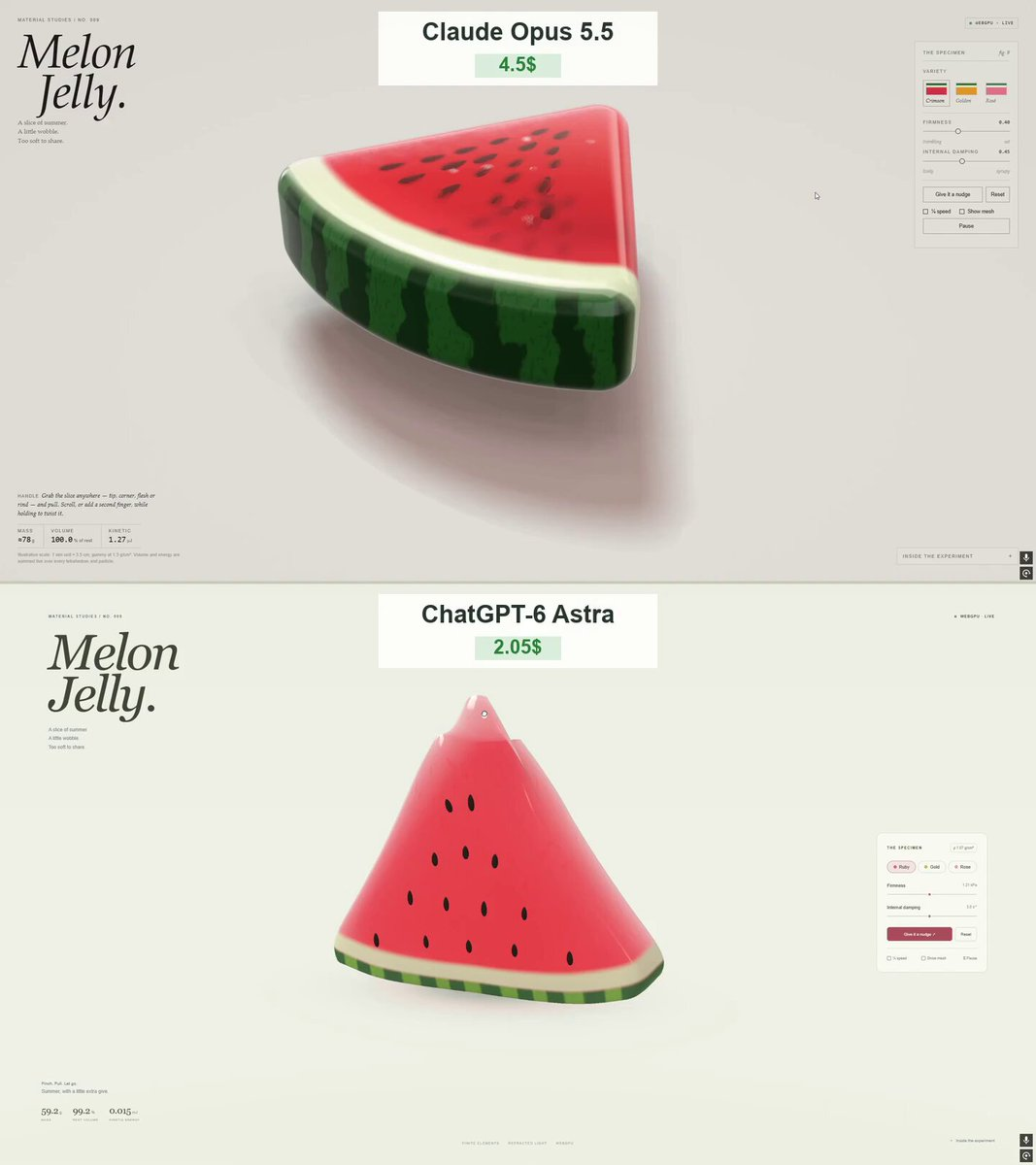
用一段结构化长提示词做出一块带软体物理效果、可拖拽的 3D 果冻西瓜片,基于 WebGPU/WGSL 实时渲染,并与 GPT-6 Astra 的版本对比。
提示词 / Prompt
English prompt
Create “Melon Jelly” - a polished, interactive 3D watermelon jelly slice that runs directly in the browser using genuine WebGPU and WGSL shaders. Deliver a single, self-contained HTML file with embedded JavaScript and CSS. This must be an actual interactive 3D simulation, not a static render, video, or 2D imitation. THE WATERMELON Create a thick, rounded triangular watermelon wedge with: Translucent ruby-red jelly flesh. A pale, slightly translucent layer between the flesh and rind. A glossy green outer rind with irregular dark-green stripes. Individually modeled dark seeds embedded in both exposed sides. Softly rounded corners and an appealing, substantial thickness. Make it look like an expensive gummy candy photographed in a studio. It should feel juicy, soft, and almost edible. Keep the colors rich without overexposing the highlights. SOFT-BODY PHYSICS Use a volumetric soft-body simulation, such as a tetrahedral mesh with XPBD elastic and volume-preservation constraints. The user must be able to: Grab the tip, a corner, the flesh, or the rind. Stretch, bend, lift, and gently twist the slice. Release it and watch it wobble before gradually settling. The slice must visibly deform locally, not simply move or scale as one rigid object. Make the rind slightly firmer than the flesh while keeping the whole slice flexible. Preserve volume reasonably during stretching. Prevent inverted elements, explosive motion, and permanent collapse. Use a fixed simulation timestep and bounded substeps for stability. After release, the motion should decay naturally - no instant snapping back and no endless oscillation. Keep seeds attached to the deforming flesh. They must move and rotate with the surface rather than float independently or remain fixed in space. Include ground contact, gentle friction, and soft bouncing. Avoid visible floor penetration. RENDERING Use native WebGPU with WGSL shaders. Include: Thickness-dependent light absorption. Refraction through the jelly. Fresnel reflections and glossy highlights. Soft transmitted light through thin edges. Subtle internal details and a few tiny air bubbles. Soft contact shadows beneath the slice. A light, neutral studio background. The flesh, pale rind, and green skin should have distinct material responses. Avoid making everything look like clear glass or opaque plastic. Keep the slice large and easy to inspect, with a three-quarter camera angle that reveals the flesh, seeds, and thickness. INTERFACE Use a minimal editorial layout with generous whitespace, thin borders, restrained controls, and no decorative UI gradients. Top left: “MATERIAL STUDIES / NO. 009” A large italic serif heading split across two lines: “Melon” and “Jelly.” Small caption: “A slice of summer.” “A little wobble.” “Too soft to share.” Top right: A small status indicator showing “WEBGPU · LIVE” when the renderer is running. Right-side panel: “THE SPECIMEN” Three coordinated watermelon-inspired color presets. Firmness slider with its current value. Internal damping slider with its current value. “Give it a nudge” and “Reset” buttons. “¼ speed” and “Show mesh” checkboxes. Pause / Resume button. Bottom left: A short hint explaining that the slice can be grabbed and stretched. Live mass, relative volume, and kinetic-energy readouts derived from the simulation. Clearly describe illustrative units or approximate values where appropriate. Bottom right: A collapsible “Inside the experiment” section briefly explaining the physics and rendering. BEHAVIOR AND PERFORMANCE Support both mouse and touch input. Use pointer capture so dragging remains reliable when the pointer leaves the object. Make the layout work on desktop and mobile without controls covering the slice. Reuse buffers and avoid rebuilding geometry or compiling shaders during dragging. Keep interaction smooth and responsive. Respect reduced-motion preferences. If WebGPU is unavailable, display a clear explanation instead of silently substituting a fake renderer. VALIDATION Test dragging from several locations, strong stretches, repeated releases, ground collisions, all sliders, presets, pause, reset, and slow motion. Check that the model returns to a stable resting shape, seeds stay attached, the mesh remains intact, and there are no rendering errors. Prioritize the quality of the jelly response and lighting. The result should be something people want to keep grabbing and playing with.
主题与风格
探索更多图片和视频提示词 · 生成图片 · 生成视频 · 在 AI 画布中创作
相关作品
- Jelly world Arctic island: Opus vs Astra
The creator compared Claude Opus 5.5 and ChatGPT-6 Astra on the same detailed prompt to build an interactive Arctic diorama in a single HTML file with native WebGPU, preferring Opus's visuals and colors.
- OpenAI agent dots animation: Opus vs GPT-6.1
The creator compared GPT-6.1 Sol Max and Opus 5.5 by making a short animation explaining how OpenAI agents work, from a simple prompt that was not published.
- Animated website from a single image: Opus vs GPT-6.1
The creator compared Claude Opus 5.5 and GPT-6.1 Sol generating animated websites from a single image, using Higgsfield MCP access for the animation, noting Opus took longer but produced more detailed results. 原作需要参考素材;请自行准备图片、视频、音频、文档或代码库等输入。
- Jelly effect model comparison
Four AI models (Mistral Large v4, Kimi K3, GPT 6.1 Sol, Claude Opus 5.5) were each asked to recreate the famous jelly effect, with results compared in a video.
- Opus vs Astra diorama comparison (Blender)
原作需要参考素材;请自行准备图片、视频、音频、文档或代码库等输入。
- Pachinko effect: Opus 5.5 version
原作者未提供提示词,可直接把视频发给 Claude Opus/Sonnet 5.5 或者以上版本作为参考视频,可直接生成同样风格。