OpenZhenZhen AI 提示词画廊 · Claude Opus 5.5 · video
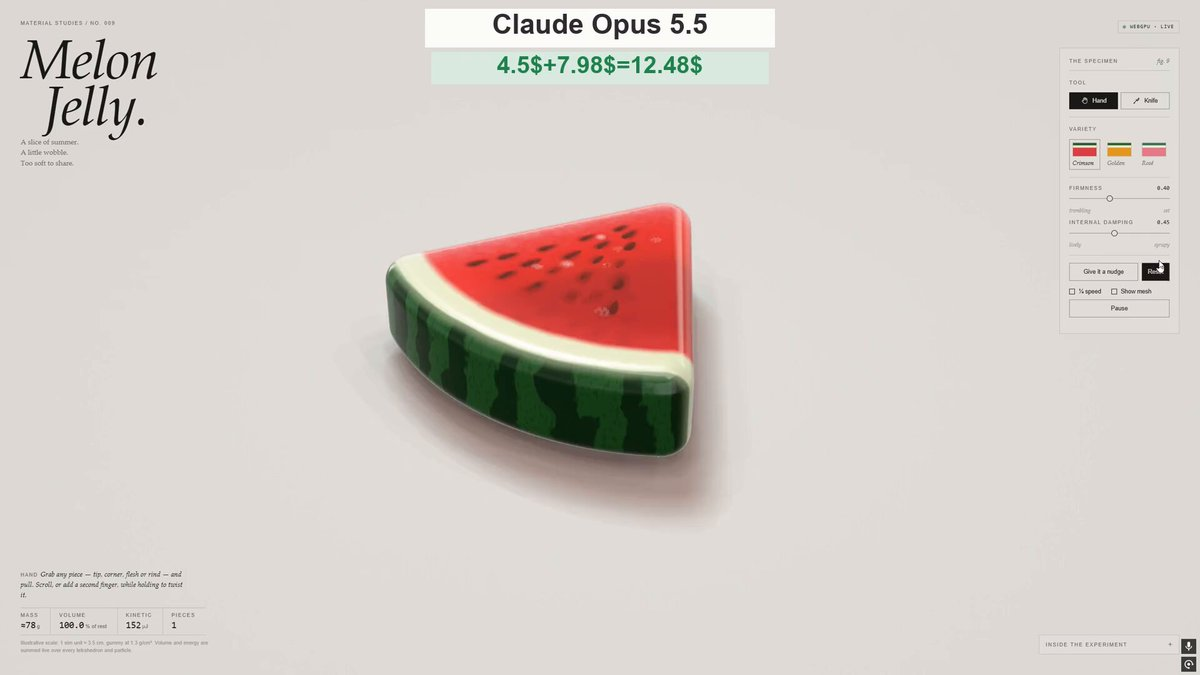
果冻西瓜切片模拟
Jelly Watermelon Slice Simulation
作者用Claude Opus 5.5根据一段详细的结构化提示词,制作了一个基于WebGPU/WGSL的果冻西瓜片交互模拟,可以用手拉扯,也能用带动画效果的刀切成多块. A reusable video recipe made with Claude Opus 5.5; explore the prompt and related works in the gallery. Topics include Claude Opus 5.5, 3D 场景.
提示词 / Prompt
English prompt
Create "Melon Jelly Knife" — a single self-contained HTML file (melon-jelly-knife.html) with an interactive, physically simulated gummy watermelon slice that you can pull like jelly AND cut into pieces with a visible steel knife that animates every cut. ── Platform ── - WebGPU + WGSL only, all JS/CSS inline, no external libraries. ES module in one <script type="module">. - If navigator.gpu / adapter is missing, show an elegant editorial fallback card ("This specimen needs WebGPU.") with a specific explanation — never fake it with a lesser renderer. Disable the controls in that state. - Recover from device loss (rebuild the renderer up to twice), surface WGSL compile errors via getCompilationInfo. - Fixed 60 Hz simulation step with an accumulator (max 3 steps/frame), ¼-speed toggle, pause (Space), keyboard: N nudge, R reset, K toggle knife, H hand. ── Page design (editorial "material study") ── - Warm paper studio backdrop #E2DFDA; the 3D floor is an infinite studio sweep that tones to exactly this colour. - Top-left masthead: small caps label "MATERIAL STUDIES / NO. 009", huge italic serif title "Melon / Jelly." (second line indented), and a 3-line serif tagline. - Top-right status pill "WEBGPU · LIVE / PAUSED / UNAVAILABLE". - Right panel (thin 1px borders, translucent paper): Tool (Hand | Knife segmented buttons with small line icons), Variety swatches (Crimson, Golden, Rosé — each recolours flesh, rind, seeds, shadow tint and the UI accent), sliders Firmness (trembling ↔ set) and Internal damping (lively ↔ syrupy), buttons "Give it a nudge", Reset, Pause, checkboxes ¼ speed and Show mesh. - Bottom-left: tool hint in italic serif, live readouts row (Mass ≈ g, Volume % of rest, Kinetic µJ, Pieces) with an "illustrative scale" footnote (1 sim unit ≈ 3.5 cm, gummy 1.3 g/cm³). - Bottom-right collapsible "Inside the experiment" notes explaining the physics, rendering and the cutting method in plain prose. - A dashed SVG guide line while drawing a knife stroke; small toast messages ("Missed — draw the blade across the slice.", "Too thin to cut there.", "That's plenty of pieces."). - The camera frames the slice inside the free area between masthead, panel and readouts (lens shift), orbits on empty-space drag, zooms on wheel, double-click resets view, gently follows the slice if it is thrown far. - Responsive: under ~860px the layout stacks (masthead, canvas ~58vh, hint, panel) with 44px+ touch targets; prefers-reduced-motion softens the intro and damping. ── The slice ── - A thick (T ≈ 0.58) wedge of watermelon: sector with ~32° half-angle, inner radius ~1.62, all corners rounded in plane (ρ = 0.17) and top/bottom edges bevelled (~0.13). - Layers by depth from the rind: dark green skin with irregular darker stripes, a pale cream-green band, then translucent red flesh; black teardrop seeds arranged in arcs and a few tiny air bubbles suspended inside. - Rendered as translucent candy: screen-space refraction of the scene behind, per-pixel thickness from a back-face depth pass, Beer–Lambert absorption per refracted tap (capped by back thickness so seeds don't halo), jittered blur, subsurface-like scatter and glow toward the key light, Fresnel + GGX highlights, soft studio environment (procedural softboxes). - Floor: PCSS-lite soft shadow from a key light behind-left-above (shadow tinted by the flesh colour), contact AO from a top-down height map. MSAA ×4, HDR, PBR-Neutral tone mapping, sRGB, dither. ── Physics (feels like real gummy candy) ── - Tetrahedral soft body (Delaunay of a jittered lattice inside the shape), XPBD with small steps (~10 substeps, 1 iteration each): • co-rotational per-tet shape matching (mass-weighted covariance, Müller quaternion rotation extraction, uniform stiffness fraction) — no inversions, no ghost torque; • per-tet volume constraints (near-incompressible); • edge relative-velocity damping controlled by the damping slider; firmness maps to shape compliance on a log scale; • floor contact with static/kinetic friction, light air drag, settle-damping when nearly at rest, speed cap, NaN guard with gentle reset. - Hand tool: grab anywhere (ray pick on the skinned surface, forgiving screen-space fallback), soft patch attachment (radius ~0.4) that follows the pointer on a camera-facing plane, reach limit, never pushed into the floor; wheel or a second finger twists the held patch. Nudge = a playful impulse. Reset drops the whole slice again. - Render mesh is skinned to the tets by barycentric embedding; normals recomputed each frame. ── Cutting into pieces ── - The world is a list of pieces. Each piece is a convex polygon I in the slice's rest plane; its outline is I dilated by a disk of radius ρ (rounded corners), extruded to the slice thickness with the same bevels, rind layers, seeds and bubbles (seeds/bubbles kept only where they fit inside). - A cut maps a world plane into each crossed piece's rest frame (best-fit rigid frame of the deformed piece), intersects it with the mid-plane → a straight line; clip I into two halves offset by ±ρ so both rebuilt outlines meet exactly at the cut; reject slivers ("too thin"). - All pieces are concatenated into ONE simulation (component id per particle) and ONE render mesh; each piece is its own soft body you can grab, stretch and cut again; pieces collide with each other (AABB-pruned particle–particle pushes, a few mm per pass so fresh faces ease apart instead of popping). Max 14 pieces. Built meshes are cached per piece so Reset is instant. - State transfer on every rebuild: new rest particles are embedded in the old tets and take over interpolated positions and velocities. ── The visible knife (the star of this version) ── - A small nakiri-style vegetable knife modelled procedurally: rectangular blade (length ~1.72, height ~0.63 — taller than the slice), straight edge with a slight lift and rounded nose at the front, thin ground bevel along the edge, flat grind to a ~0.03 spine, sharp creases (duplicated vertices), polished steel bolster, oval walnut handle that swells slightly with three steel rivets and flat end caps. Local frame: +x toward the tip, edge on y=0. - Materials in the scene shader: brushed steel with a product-shot gradient (dark board reflected low, bright sweep high), softbox streaks, satin lighter bevel, mirror bolster; walnut with straight grain, satin oil sheen, rivets. Posed rigidly on the CPU each frame. - The knife is drawn in the scene pass (behind the jelly surface), so the part buried in the jelly is seen refracted through it; it casts a shadow but stays out of the AO height map. - Behaviour: • Hover (knife tool): the knife floats ~0.42 above the slice with its edge exactly under the cursor, blade side-on to the camera, slightly rolled toward the viewer; it drops in from above when the tool is selected; hidden in hand mode. • While drawing: it lines up along the stroke, edge just above the jelly, handle always on the left (canonical direction relative to camera right). • On release: the stroke read on the surface it was drawn over defines a VERTICAL blade plane; the split is planned and the new pieces + new soft body are pre-built immediately (so the swap later costs only ~10 ms and there is no hitch mid-animation). • Choreography (~1.1 s, respects ¼ speed and pause): align (0.16 s) → press: the edge sinks ~0.13 below the top and a physical collider pushes the jelly into a rounded groove under it — it squashes before it gives (to 0.42 s) → break-through: the new world is swapped in, the blade continues to the board while a wedge collider eases the two new faces apart (limited to a few mm per substep, gap growing with depth) and holds the cut lips down at the break-through depth → short hold → lift back to hover, releasing the lips so they spring back with a jiggle. • Misses show a toast and the knife stays put; new strokes are ignored while a cut is animating; Reset cancels it. ── Quality bar ── - Smooth 60 fps on a mid-range laptop GPU; no allocations in the frame loop except on cuts. - Deterministic test hook on window (e.g. __melon with sim, camera, pick, planCut, startCut, advance(seconds), per-piece stats) so the animation can be stepped and screenshotted. - Polished, calm, museum-like typography; everything readable on phone and desktop.
主题与风格
探索更多图片和视频提示词 · 生成图片 · 生成视频 · 在 AI 画布中创作
相关作品
- Self-portrait drawing with piano score
Explore AI image and video prompts, reusable generation recipes, and creator-made inspiration with OpenZhenZhen's online AI tools.
- Engineered flying wing aircraft model
Explore AI image and video prompts, reusable generation recipes, and creator-made inspiration with OpenZhenZhen's online AI tools.
- Tool to convert icons into 3D assets
Explore AI image and video prompts, reusable generation recipes, and creator-made inspiration with OpenZhenZhen's online AI tools.
- Procedural 3D Napoleon field cannon
Explore AI image and video prompts, reusable generation recipes, and creator-made inspiration with OpenZhenZhen's online AI tools.
- Nibs and the Sleeping Tortoise
Explore AI image and video prompts, reusable generation recipes, and creator-made inspiration with OpenZhenZhen's online AI tools.
- Music-driven Blender visual scene
Explore AI image and video prompts, reusable generation recipes, and creator-made inspiration with OpenZhenZhen's online AI tools.