OpenZhenZhen AI 提示词画廊 · Claude Opus 5.5 · video
互动果冻压榨玩具
Interactive Jelly Squeeze Toy
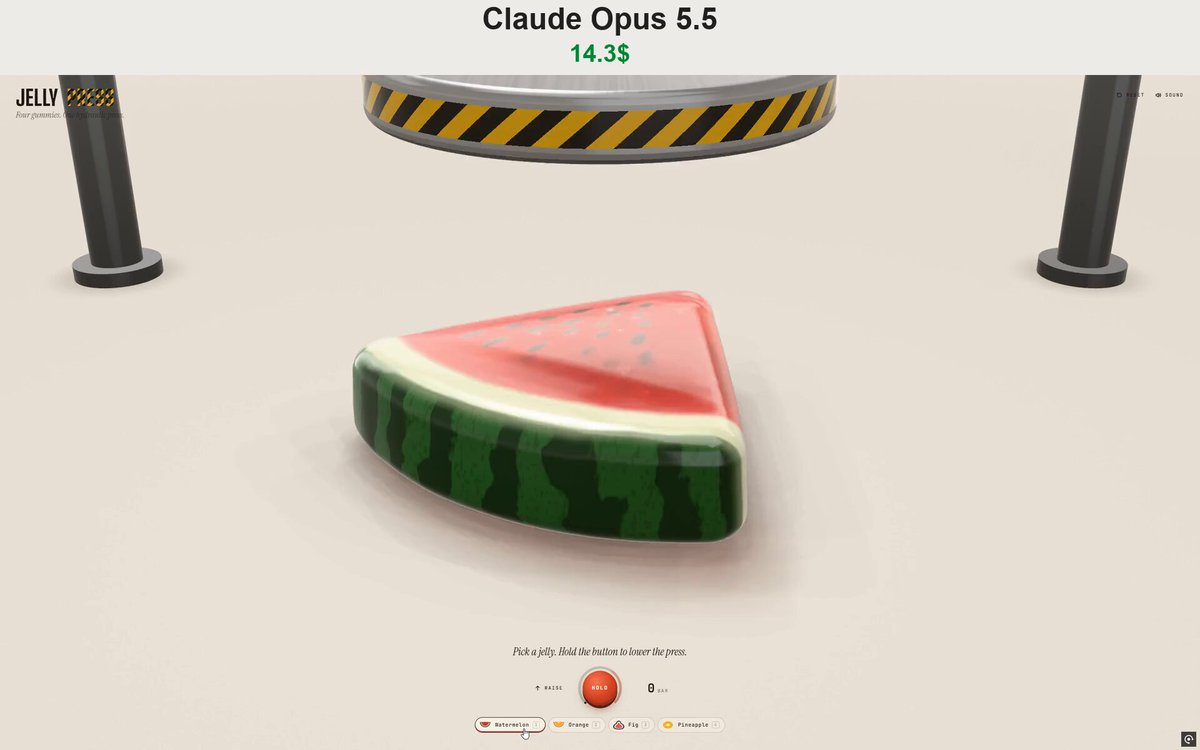
一款互动3D果冻挤压玩具,带液压压机效果,由Claude Opus 5.5根据一次详细提示一次性生成为单文件HTML/WebGPU应用,预估API成本14.30美元。
提示词 / Prompt
English prompt
Create "Jelly Press": a single-file interactive 3D toy in HTML (all JS, CSS and WGSL shaders inline, no external assets except Google Fonts). Render with WebGPU; if WebGPU or an adapter is missing, show a clean fallback message instead of a blank page. CONCEPT Four translucent gummy jellies shaped like fruit slices sit one at a time on the steel bed of a hydraulic press. The player holds a big red button to lower the press. The jelly squashes and spreads, the pressure gauge climbs, and somewhere past half its height it bursts into pieces. After the burst the game does NOT end: the player can grab the pieces, drag them, throw them around, and squash them again. THE JELLIES (chips at the bottom, keys 1–4) 1. Watermelon wedge (half-disc slab): red flesh with dark teardrop seeds, a pale rind band, a green striped skin. 2. Orange slice (half-disc): orange pulp segments separated by thin white membranes, pale pith, orange peel. 3. Fig half: pink flesh full of small golden seeds, a cream layer, a dark purple skin. 4. Pineapple ring: golden fibrous flesh with radial streaks and a hole in the middle. Each jelly should look like real gummy candy: subsurface scattering, soft translucency, glossy specular highlights, soft shadows on a warm studio floor (cream/beige, tone-mapped). PHYSICS (CPU, fixed 60 Hz step) - XPBD tetrahedral soft body with 8 substeps: co-rotational per-tet shape matching, per-tet volume constraints, hard edge strain limits (0.35×–1.8×), edge velocity damping, floor contact with Coulomb friction, rolling resistance, and gentle settling when nearly still. - Render mesh skinned on the CPU through barycentric embedding in the tets; normals recomputed from triangles every frame. - The press die is a kinematic round platen (radius ~1.05, rounded edge, a thickness, a ram above it). It acts as a ceiling with friction below, a shelf on top, and a side wall at its rim. The two press posts are solid. - Pressure readout in bar comes from the platen's contact load, scaled per fruit. THE BURST - Break at a random squash between 52% and 66% of the jelly's height. - Plan the fracture in the background shortly after each round starts, so the burst itself is instant. - 5–7 big pieces from 3D Voronoi cells with slightly tilted walls. On 3–4 of them, a far corner is chipped off by two cutting planes and split further into 2–4 small chips, which leaves jagged, notched edges. - Assign tets to cells by centroid. Duplicate particles per chunk. Merge tiny islands into their neighbours. - The new body adopts the old positions and velocities. - Clip the skin triangles against each cell's half-spaces, and fill every cut face with a clean flat cap showing the fruit's interior (flesh, seeds, membranes). No stretched triangles, no holes. - Kick pieces outward and upward from the press. Small chips fly faster and higher and tumble with random spin. - Show a big italic verdict for about 2.5 s, then fade it: "Splat." (melon), "Squeezed." (orange), "Well, that's jam." (fig), "Crushed." (pineapple). Include a stat line: "Gave up at N bar and N% of its height." AFTER THE BURST: PLAY MODE - Picking: ray/triangle test against the skinned mesh, with a forgiving screen-space fallback for touch. - Grabbing pins the grabbed patch (radius ~0.4, only particles of that chunk) to a target on a camera-facing drag plane. Small chips move whole; big pieces stretch and swing like jelly. - Releasing throws the piece with the pointer's velocity. - Pieces collide with each other. A particle found inside another chunk's tet is pushed out through that chunk's nearest skin face, with friction. Use a chunk AABB broad phase and a spatial hash of skin tets. - Pieces stay on stage: side walls, plus an invisible front edge so nothing ends up under the controls or behind the camera. - The press still works: hold to squash the pieces again (no second fracture); Raise lifts the platen. - Wet "plop" sounds on landings; a small squelch on grab. - Cursor: open hand over pieces, closed hand while dragging. Dragging empty space orbits the camera. UI (editorial, minimal) - Masthead top-left: "JELLY PRESS" in bold condensed caps, with "PRESS" filled in yellow/black hazard stripes. Subtitle: "Four gummies. One hydraulic press." - Top-right: Reset and Sound toggle. - Bottom deck: - Caption line with escalating captions while pressing: "Contact." → "It's fine. It's jelly." → "Getting wider." → "That's a pancake now." → "It's making a noise." → "Please." - Circular pressure dial (0–400 bar arc, red zone) around a red HOLD button, a Raise button, and a big numeric bar readout. - Fruit chips with icons. - In play mode the caption slot shows "Grab a piece. Throw it." with small "Press again" and "Next jelly" buttons. - Controls: hold Space or ArrowDown to press, ArrowUp to raise, R to reset, 1–4 to pick a fruit. Wheel zooms; double-click resets the view. - Camera: low bench-level view; the press frame yaws per fruit so the posts never block the jelly. Framing adapts so the jelly sits between masthead and deck; works on phones (portrait) with a narrower stage. SOUND (procedural Web Audio, no files) Hydraulic motor hum that rises with pressure, wet squelches, occasional creaks at high pressure, a valve clunk when the platen stops, a loud burst, soft plops on landing. Unlock on first interaction. QUALITY BAR - Smooth 60 fps on a laptop. - Background warm-up of the other fruits' meshes and shaders so switching is instant. - Respect prefers-reduced-motion. - Accessible labels, a gauge with role=meter, focus-visible outlines. - No console errors. The page never goes blank.
主题与风格
探索更多图片和视频提示词 · 生成图片 · 生成视频 · 在 AI 画布中创作
相关作品
- Self-portrait drawing with piano score
Claude Opus 5.5 drew self-portraits using JavaScript and composed an accompanying piano score, part 2 of a series.
- Engineered flying wing aircraft model
An interactive 3D flying wing aircraft with hidden fans, battery cells and a cutaway view, engineered with Claude Opus 5.5 and viewable in a browser lab.
- Tool to convert icons into 3D assets
A tool that converts icons or illustrations into customizable 3D assets, built using Claude Opus 5.5.
- Procedural 3D Napoleon field cannon
The creator used Claude Opus 5.5 to build a procedurally generated, interactive 3D model of an 1857 Napoleon field cannon using Three.js WebGPU and TSL shaders, with live orthographic technical drawings.
- Nibs and the Sleeping Tortoise
A 3D-animated short of a beaver character named Nibs was created by first generating a character reference sheet with GPT Image 2.5 on Vidfield, then feeding that reference into a detailed Seedance 2.5 video prompt, with Opus 5.5 used in the process. 原作需要参考素材;请自行准备图片、视频、音频、文档或代码库等输入。
- Music-driven Blender visual scene
A 20-second hyper-real psychedelic music video was made by Opus 5.5, which composed the track in Suno, analyzed its audio, and built and animated the scene live in Blender via MCP using a detailed published prompt. 原作需要参考素材;请自行准备图片、视频、音频、文档或代码库等输入。