OpenZhenZhen AI 提示词画廊 · Claude Opus 5.5 · video
Browser octopus physics comparison
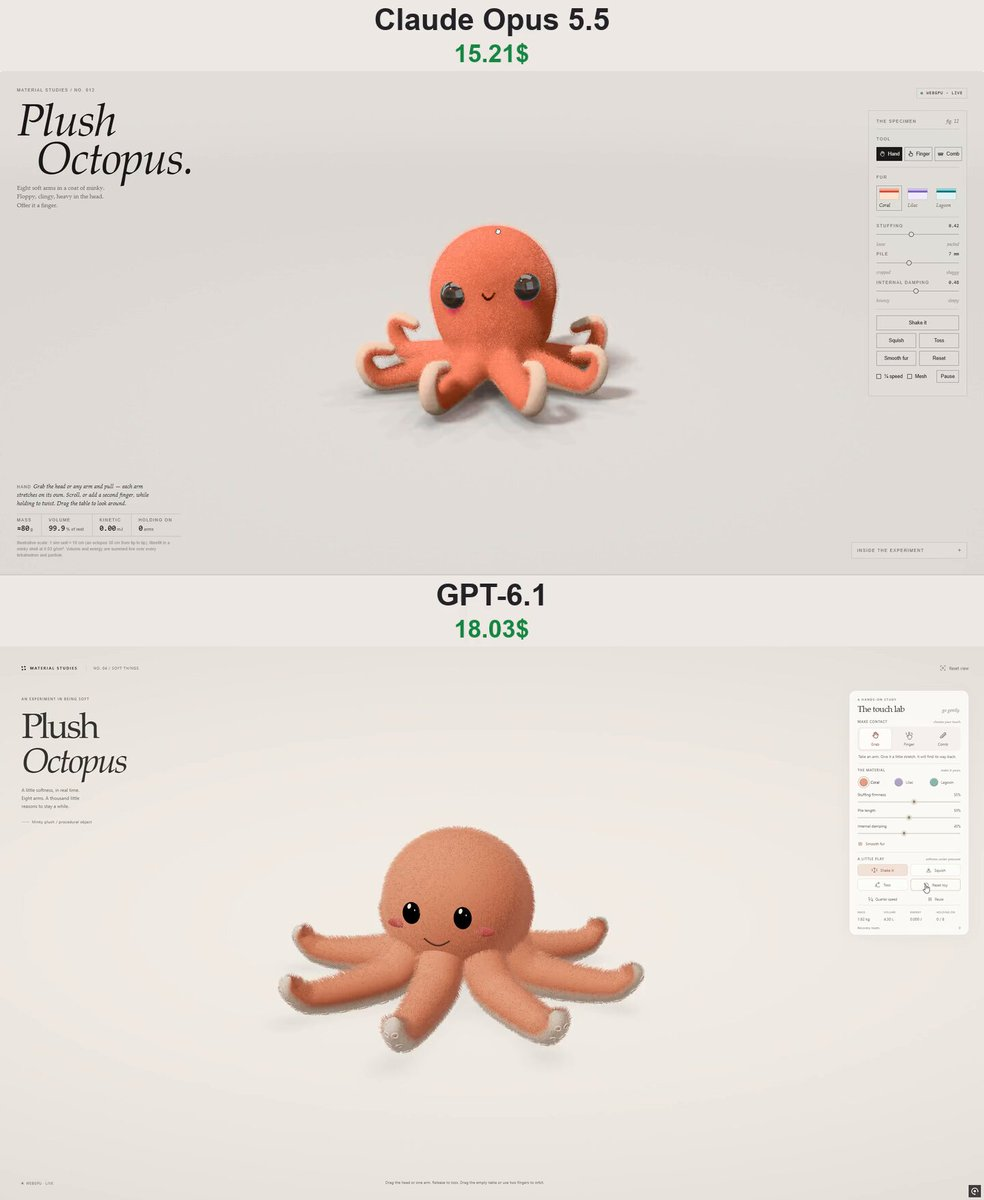
A procedural WebGPU plush octopus has fur, soft-body physics, touch controls, and several interaction tools. The creator compared Claude Opus 5.5 with GPT-6.1 Sol.
提示词 / Prompt
English prompt
Create an interactive 3D "Plush Octopus" toy as a single self-contained HTML file using native WebGPU. A cute stuffed octopus sits on a soft studio table: a big round head with two glossy black safety-bead eyes, embroidered blush cheeks and a small stitched smile, and eight chubby tapering arms that lie on the table and curl up at the tips, revealing a paler underside with rows of sucker discs. Make it look like real minky plush: dense real-time fur with visible strands, soft sheen, fur that sways when the toy moves, and soft contact shadows. Interactions: - Drag the head or any single arm to stretch it independently; arms must stay connected to the body and never pass through each other or the head. - "Finger" tool: a finger follows the pointer above the octopus. Nearby arms reach up for it; press to lower it and the arms wrap around it and hold on. Moving or lifting the finger drags or lifts the octopus until the arms let go. Poking the head dents it. - "Comb" tool: stroke the fur to change its direction; against the grain it looks darker, with the grain it shines. Add a "Smooth fur" button. - "Shake it" button: pick the octopus up by the crown and shake it so the arms flop and swing like soft sausages, then set it down. - Squish (press down from above), Toss, and Reset. If it lands upside down, it slowly rolls back onto its arms. Controls: three fur colours (Coral, Lilac, Lagoon), sliders for stuffing firmness, pile length, and internal damping, quarter speed, pause. Support mouse and touch, camera orbit, and zoom (scroll or pinch). Use an elegant editorial "material study" layout: a large serif title, a compact control panel, and live readouts (mass, volume, kinetic energy, arms holding on). Generate all geometry, materials, and fur procedurally: no external libraries, models, textures, or other assets. Prioritize believable soft-body physics, stable simulation, and a cosy, polished look.
主题与风格
探索更多图片和视频提示词 · 生成图片 · 生成视频 · 在 AI 画布中创作
相关作品
- Jelly world Arctic island: Opus vs Astra
The creator compared Claude Opus 5.5 and ChatGPT-6 Astra on the same detailed prompt to build an interactive Arctic diorama in a single HTML file with native WebGPU, preferring Opus's visuals and colors.
- OpenAI agent dots animation: Opus vs GPT-6.1
The creator compared GPT-6.1 Sol Max and Opus 5.5 by making a short animation explaining how OpenAI agents work, from a simple prompt that was not published.
- Animated website from a single image: Opus vs GPT-6.1
The creator compared Claude Opus 5.5 and GPT-6.1 Sol generating animated websites from a single image, using Higgsfield MCP access for the animation, noting Opus took longer but produced more detailed results. 原作需要参考素材;请自行准备图片、视频、音频、文档或代码库等输入。
- Jelly effect model comparison
Four AI models (Mistral Large v4, Kimi K3, GPT 6.1 Sol, Claude Opus 5.5) were each asked to recreate the famous jelly effect, with results compared in a video.
- Opus vs Astra diorama comparison (Blender)
原作需要参考素材;请自行准备图片、视频、音频、文档或代码库等输入。
- Pachinko effect: Opus 5.5 version
原作者未提供提示词,可直接把视频发给 Claude Opus/Sonnet 5.5 或者以上版本作为参考视频,可直接生成同样风格。