Галерея ИИ-промптов OpenZhenZhen · gpt-image-2.5 · image
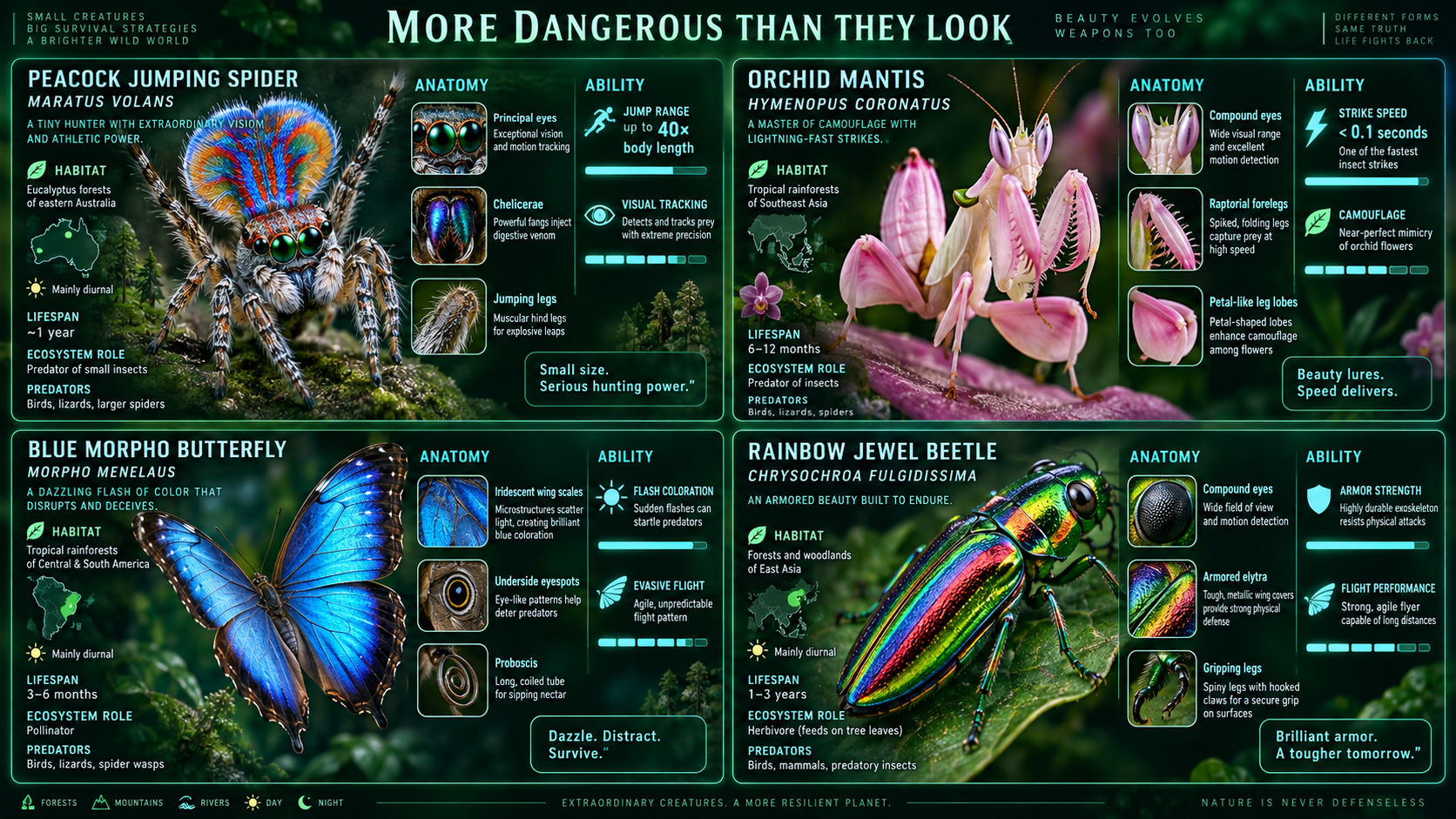
Макроинфографика четырёх редких членистоногих
Macro Infographic of Four Rare Arthropods
«Макроинфографика четырёх редких членистоногих» — работа с использованием gpt-image-2.5 на OpenZhenZhen. Изучите исходный промпт и пример генерации для собственных проектов.
Промпт
Промпт на китайском
在16:9画布上创作一张超清现代宏观生物学信息图,并明确分成2×2网格。主题是四种著名且外观稀有的节肢动物,它们的捕食或防御适应比鲜艳外表所暗示的更强。每格只放一种细节极丰富的宏观标本,并固定按阅读顺序排列:左上为孔雀跳蛛 Maratus volans,右上为兰花螳螂 Hymenopus coronatus,左下为蓝闪蝶 Morpho menelaus,右下为彩虹吉丁虫 Chrysochroa fulgidissima。不得替换成泛称虫子,也不得重复物种。每个标本都是该格核心视觉,以倾斜三分之四视角或轻微3D漂浮视角呈现,解剖结构真实,天然虹彩鲜明醒目。 在每个标本周围建立紧凑但通透的编辑信息系统。用发光矢量引线指向相关解剖部位,并配合小型功能插图或显微扫描嵌图。孔雀跳蛛突出主眼、大颚和跳跃足;兰花螳螂突出复眼、捕捉足和花瓣状足叶;蓝闪蝶突出虹彩翅鳞、翅背眼斑和喙管;彩虹吉丁虫突出坚硬鞘翅、复眼和抓握足。标注围绕主体形成放射状信息流,并清楚连接到正确标本。 在各核心标本周围用干净的数据图表、编号面板、进度条、全息气泡或徽章呈现行为与栖息地统计。只比较恰当的能力,例如跳蛛的跳跃距离与视觉追踪、螳螂的伪装与出击速度、蝴蝶的闪光色与规避飞行、吉丁虫的护甲与飞行表现。可补充栖息地、寿命、生态角色以及捕食者或猎物关系。将危险性限定为生态捕食或防御能力,不宣称每种标本都对人类危险。按需加入叶片、蛛网、太阳和月亮小图标,使阅读逻辑从标本依次流向解剖、能力和栖息地。 把《国家地理》式宏观摄影与精致的科幻生物实验室界面结合。使用鲜艳的虹彩标本色、微妙的生物发光投影、清晰的霓虹青色或实验室绿色矢量线、现代字体、深色磨砂玻璃数据面板,以及深森林绿到黑色的极简纹理渐变背景。每个标本以电影感轮廓光和受控的微距高光照亮,同时保留可信材质纹理与清晰可读性。保持充足留白和明确层级:标本第一、解剖第二、统计第三。四格视觉系统统一,同时各自易读。 总标题必须准确写为“MORE DANGEROUS THAN THEY LOOK”。四格使用准确的英文常用名和学名:“PEACOCK JUMPING SPIDER — MARATUS VOLANS”、“ORCHID MANTIS — HYMENOPUS CORONATUS”、“BLUE MORPHO BUTTERFLY — MORPHO MENELAUS”和“RAINBOW JEWEL BEETLE — CHRYSOCHROA FULGIDISSIMA”。重复使用栏目标签“ANATOMY”、“ABILITY”和“HABITAT”。文字必须锐利且拼写正确。最终呈现超清晰、高级实验室质感、适合社交媒体信息流的成品。不要人物、人脸、身份参考、水印、签名、无关标志、无关文字、畸形解剖、重复标本或拥挤难读的数据。
Промпт на английском
Create an ultra-clean modern macro-biology infographic on a 16:9 canvas divided into a clear 2x2 grid. The theme is four famous rare-looking arthropods whose predatory or defensive adaptations are more formidable than their colorful appearance suggests. Put exactly one hyper-detailed macro specimen in each cell, in this fixed reading order: top left, a peacock jumping spider, Maratus volans; top right, an orchid mantis, Hymenopus coronatus; bottom left, a blue morpho butterfly, Morpho menelaus; bottom right, a rainbow jewel beetle, Chrysochroa fulgidissima. Do not substitute generic bugs or repeat a species. Show every specimen as the hero visual in an angled three-quarter or slight 3D floating view, with realistic anatomy and striking iridescent natural color. Around each specimen, build a compact but airy editorial information system. Use glowing vector leader lines to point to relevant anatomy, supported by small function illustrations or microscopic scan insets. For the peacock jumping spider, emphasize the principal eyes, chelicerae, and jumping legs; for the orchid mantis, the compound eyes, raptorial forelegs, and petal-like leg lobes; for the blue morpho, the iridescent wing scales, underside eyespots, and proboscis; for the rainbow jewel beetle, the armored elytra, compound eyes, and gripping legs. Arrange the callouts in a radial flow that visibly connects them to the correct specimen. Add behavioral and habitat statistics around each hero using clean data graphs, numbered panels, progress bars, holographic bubbles, or badges. Compare only appropriate capabilities such as jump range and visual tracking for the spider, camouflage and strike speed for the mantis, flash coloration and evasive flight for the butterfly, and armor and flight performance for the beetle. Include habitat, lifespan, ecosystem role, and predator or prey relationships where useful. Frame danger as ecological predation or defense rather than claiming that every specimen is dangerous to humans. Add small leaf, web, sun, and moon icons where relevant, keeping a logical reading flow from specimen to anatomy to abilities and habitat. Combine National Geographic-style macro photography with a polished sci-fi bio-lab interface. Use vibrant iridescent specimen colors, subtle bioluminescent drop shadows, crisp neon-cyan or bio-lab-green vector lines, modern typography, dark frosted-glass data panels, and a deep forest-green-to-black minimal textured gradient background. Light each specimen with cinematic rim light and controlled macro highlights while retaining believable material texture and legibility. Preserve generous negative space and a clear hierarchy: specimen first, anatomy second, statistics third. Keep all four cells visually related but individually readable. Set the overall title exactly as “MORE DANGEROUS THAN THEY LOOK”. Label the four cells with the exact common names and scientific names “PEACOCK JUMPING SPIDER — MARATUS VOLANS”, “ORCHID MANTIS — HYMENOPUS CORONATUS”, “BLUE MORPHO BUTTERFLY — MORPHO MENELAUS”, and “RAINBOW JEWEL BEETLE — CHRYSOCHROA FULGIDISSIMA”. Use the recurring section labels “ANATOMY”, “ABILITY”, and “HABITAT”. Render the typography sharply and correctly. Finish as an ultra-crisp premium laboratory infographic optimized for a social feed. No people, human faces, identity reference, watermark, signature, unrelated logo, unrelated text, malformed anatomy, duplicated specimen, or cluttered unreadable data.
Темы и стили
Больше промптов для изображений и видео · Создать изображение · Создать видео · Создать на ИИ-холсте
Похожие работы
- Детский научно-познавательный плакат: Знакомство с пчёлами
«Детский научно-познавательный плакат: Знакомство с пчёлами» — работа с использованием gpt-image-2.5 на OpenZhenZhen. Изучите исходный промпт и пример генерации для собственных проектов.
- Ретро-модульный инфографический дизайн туристического плаката
«Ретро-модульный инфографический дизайн туристического плаката» — работа с использованием gpt-image-2.5 на OpenZhenZhen. Изучите исходный промпт и пример генерации для собственных проектов.
- Создание инфографики рецепта
«Создание инфографики рецепта» — работа с использованием gpt-image-2.5 на OpenZhenZhen. Изучите исходный промпт и пример генерации для собственных проектов.
- Современная интернациональная инфографическая PPT-система на тему привычной лжи
«Современная интернациональная инфографическая PPT-система на тему привычной лжи» — работа с использованием gpt-image-2.5 на OpenZhenZhen. Изучите исходный промпт и пример генерации для собственных проектов.
- Инфографический постер с тосканской пастой с томатами и базиликом
«Инфографический постер с тосканской пастой с томатами и базиликом» — работа с использованием gpt-image-2.5 на OpenZhenZhen. Изучите исходный промпт и пример генерации для собственных проектов.
- Вертикальная взрыв-схема элитного напитка
«Вертикальная взрыв-схема элитного напитка» — работа с использованием gpt-image-2.5 на OpenZhenZhen. Изучите исходный промпт и пример генерации для собственных проектов.